Secrets Of Mosfet Cross Reference and Replacement Guide
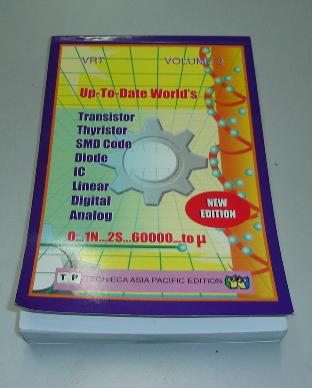
A Semiconductor Replacement Guide Searching for the right mosfet cross reference or datasheet, one has to look for a semiconductor transistor replacement data book and not the Philip ECG master replacement guide. Almost all the transistor replacement book will published out the specification of a particular components such as type of component it belong whether it is a fet, scr, bipolar transistor, horizontal output transistor and also the voltage, ampere, wattage, ohm, frequency and suggested substitution part number.
From my experienced, the substitution part number that was recommended by the data book is not always 100 % match. If you have the time, I would like to suggest to you that, find the right part number by yourself rather than depending on the transistor data book.
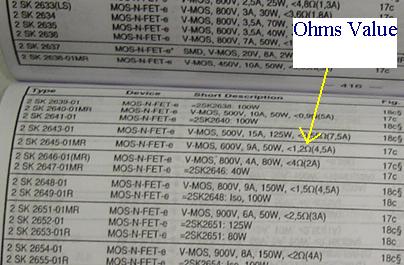
It is the same when you look for horizontal output transistor (HOT) specification which doesn't mean that the bigger specification, the better the substitution part number is. In searching for Mosfet cross reference, you have to look at the ohms value which is provided by the transistor data book besides the specification of voltage, ampere and the wattage. The replacement, besides the same or higher in voltage, ampere and wattage, one should also consider the ohms value. The ohms value has to be as close as possible.
Arrow is showing the mosfet ohms value in a transistor substituion book
If the original fet part number is 1 ohm then a good replacement mosfet must have the ohm values between of 0.5 to 1.5 ohm. Do not substitute it with a too high or too low ohms value as this will make the mosfet run warmer and eventually blow the mosfet itself. Even though you can get a replacement with a higher voltage, ampere and wattage, if the ohms value is too low or too high, the mosfet will still burnt after on for quite a while.
It runs well for sometimes before it breakdown again. After two weeks the customer brought back the printer with the same complaint which is no power. Upon checking the power side I found the same mosfet gave up again. Substituting with another mosfet part number that have a similar specification especially the ohms value solved the printer no power symptom.
Specification with larger voltage, ampere and wattage don’t guarantee that the replacement mosfet will work. So, taking the mosfet ohms value into consideration, you will have a higher chances to repaired the equipment and sometimes the replacement mosfet will also last longer.
|
|
Perfectly-clear-workbench-4-3-0-2403-full-version -
Instead of analyzing each image in a folder independently, the Smart Group Session analyzes the first 5–10 images to identify the "Key Lighting Setup" and "Subject Profile" of a photoshoot. It then creates a temporary, session-specific AI model to ensure 100% consistent skin tone, lighting correction, and eye enhancement across all 1,000+ images in that folder. Key Enhancements:
In conjunction with Auto Crop, it ensures all headshots maintain the same aspect ratio and vertical positioning, reducing manual re-adjustments in Lightroom. perfectly-clear-workbench-4-3-0-2403-full-version
Perfectly Clear Workbench already provides automatic scene detection and face-aware portrait enhancements. This new feature, "Smart Group Session," would bridge the gap between individual image correction and consistent, multi-image batch editing for portrait sessions. Instead of analyzing each image in a folder
Compare this to the mentioned in the search results If you'd like, I can: Draft a technical
This leverages the existing ability of to "tweak presets" and "detect scenes" (like new, night, sunset, etc.) while directly addressing the high-volume workflow needs of "photo labs and production teams" that use this tool. If you'd like, I can: Draft a technical implementation plan for this feature
Detail how this interacts with the
It identifies if the subject is on a dark background or green screen and applies the appropriate AI white balance automatically.
Copyright@ 2006-2014-www.ElectronicRepairGuide.com All Rights Reserved